
How to Get Better at Wrestling.

You rehearse the basics until it is second nature. You wrestle live often enough to utilize them when it counts. You develop the conditioning and mindset to keep doing it when you are exhausted. The rest is detail. The wrestlers that progress the fastest are not the ones that learn the most maneuvers. They are the ones that learn a few reliable abilities, put them in the appropriate order, and then get relentless reps using them against genuine resistance.
This tutorial explains how to achieve this whether you are a first year wrestler attempting to win your first bout, a parent trying to help without getting in the way, or a coach designing practices for a room full of youngsters. It’s based on a simple concept called the Skill Stack and features a practice template you can try today, a weekly checklist, and a straight-talk piece on decreasing weight healthily.
Key Takeaways
- Fundamentals trump flashy moves. Stance, motion, level shift, penetration and finishes win more matches than a highlight-reel throw you hit once a season.
- Drill for the skill, go live for the app. Both are important things. Drilling builds the maneuver, live wrestling teaches you how to use it while someone is fighting back.
- Train all three positions. Bottom and top. Neutral. Most wrestlers put too much emphasis on takedowns and lose matches on the mat.
- Conditioning is a weapon. A better gas tank allows you to continue to score in the third quarter as your opponent tires.
- Cut weight or not, cautiously. Rapid weight loss is especially risky for youth wrestlers. Follow the safety instructions below.
The short answer: What genuinely makes wrestlers better
“Wrestling gets better from four things working together: repetition of correct fundamentals, live wrestling against resistance, sport-specific conditioning and strength, and mental preparation including film study. Add reasonable weight and nutrition management and you have the complete picture.
If you remember only one line, remember this: drill the basics to the point of boredom, then go live to the point of automatic. Progress slows when a wrestler chases new moves before owning the simple moves, or drills constantly but never wrestles live, or has outstanding technique but gasses in the second period.
The Skill Stack: the order to build wrestling skills in
The Skill Stack is a simple way to prioritize what to work on. Think of your wrestling ability as three layers built on top of each other. You do not skip a layer. A weak base makes everything above it shaky.
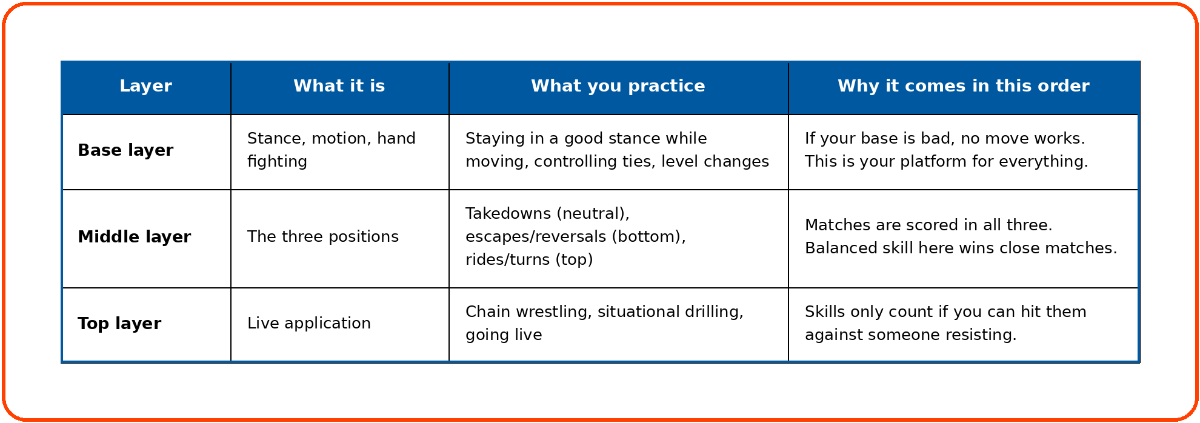
Base layer: stance, movement and hand fighting
Your position is the foundation of all. A proper posture is athletic and balanced: bent knees, down hips, straight back, up head, in elbows, weight on the balls of your feet. Movement keeps you tough to score against and sets up your own attacks from there. You should be able to go forward, backward, and side to side without rising up or crossing your feet.
Hand fighting is the way you win the exchange before the shot. With tie controls (collar tie, underhook, wrist control) you may control position and create apertures. Beginners who learn to hand fight stop getting scored so readily and start setting up their own offense.
Drill it: Spend five minutes every practice on stance-and-motion. Add a partner for "hand fighting only" rounds where the goal is to win inside position, no shooting allowed.
Middle layer: the three positions
Folkstyle and scholastic wrestling are scored in three positions, and you need competence in all of them:
- Neutral (on your feet): where takedowns happen.
- Bottom: where you work to escape or reverse.
- Top: where you ride, wear your opponent down and attempt to turn them for near-fall points or a pin.
The error so many people make is they focus most of their attention on takedowns, because takedowns are enjoyable, and they ignore bottom and top. Then they lose a game because they can’t score in the third period. Balance all three in training.
Top layer: live application and chain wrestling
The skills at the top of the stack are applied against genuine resistance. Chain wrestling involves tying your moves together so that if your first attack is defended, you quickly flow into the next one. You get defended on one leg, you go for a high crotch, that gets stuffed, you go for a body lock. Chain wrestling is only built through situational drilling and live wrestling. It is the difference between just drilling and actually scoring.
Master the fundamentals first (with drills)
The fastest approach to improve is to automate your top percentage techniques. Here are the core areas with a beginner drill for each:
Neutral: takedowns
First, focus on the level change, the penetration step, and the finish. Most beginners shoot from too far away, from a lousy angle or without changing levels and therefore get splayed upon. The double leg, single leg and high crotch are the most successful takedowns to design a game around.
Drill it: Step drills across the mat (changing levels, stepping in, coming up) Penetration step drills Partner drilling: Light to progressive resistance from your partner. Finish every shot. Don't stop at the entry.
Bottom: escapes and reversals
From the bottom, your bread and butter are the stand-up and the sit-out, plus the switch and granby as reversals. The key is moving immediately on the whistle and creating motion before your opponent settles their weight.
Drill it: "Whistle drills" where you explode into your stand-up the instant the drill starts, and hip-heist/motion drills to build the movement pattern.
Top: rides and turns
On top, your job is to break your opponent down flat, ride legally, and turn them for back points. Learn a reliable breakdown (like a tight waist and ankle), a ride, and one or two turns such as the half nelson or a cradle.
Drill it: Breakdown-to-ride-to-turn sequences, and "get to the pin" situational drilling where you start already on top and must finish.
Drilling vs. live wrestling: how to split your mat time
You need both, and they do different jobs. Drilling builds correct movement through repetition. Live wrestling teaches you to apply that movement against someone actively stopping you. Drill-only wrestlers look great in the room and struggle in matches. Live-only wrestlers reinforce sloppy habits.
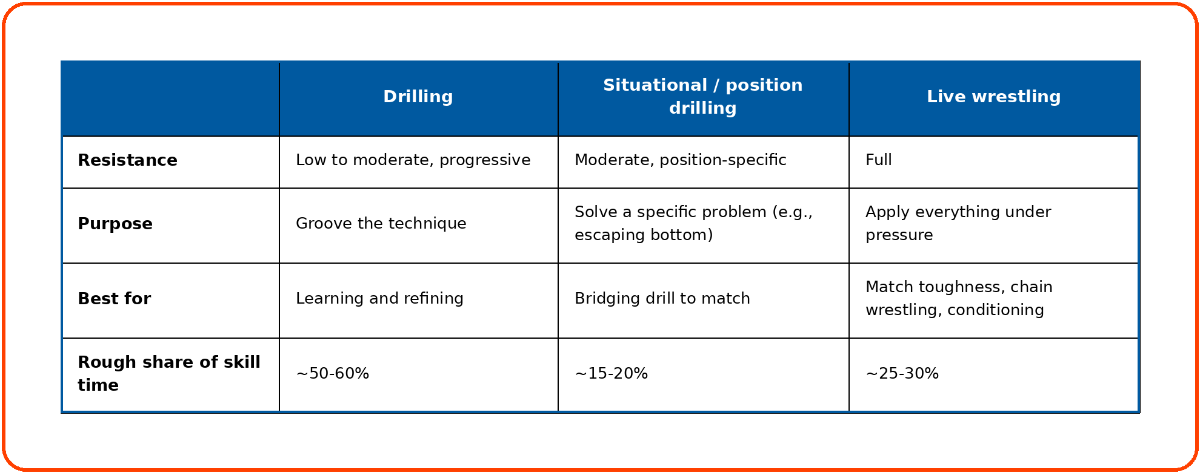
The share numbers above are a practical starting point, not a rule. Newer wrestlers should lean more toward drilling; experienced competitors closer to a match should lean more live.
A useful progression for any technique: drill it slow and correct, then drill it with progressive resistance, then use it in situational live, then use it in full live. That ladder is how a move becomes a match skill.
How often should you practice wrestling to improve?
Most youth and high school wrestlers grow steadily by practicing several times a week during the season, with technique, live wrestling and conditioning all represented, plus rest days for recovery. It’s much better to be regular over months than to have occasional heroic sessions.
Whatever the exact number, two principles apply:
- Frequency is skill, not intensity You will learn more wrestling in 3 times a week for a year than cramming.
- Recovery is practice. Athletes need sleep to grow. And days off. Overtraining leads to injury and burnout, which is the reverse of improvement.
- Big jumps are made in the off-season. Freestyle and Greco-Roman in the spring and summer, wrestling camps, strength work to establish a base that will show up next season.
A straightforward 60-minute practice template you can implement today
This is a round session working all three positions and conditioning. Coaches can scale it; individual wrestlers can adapt it with a partner.
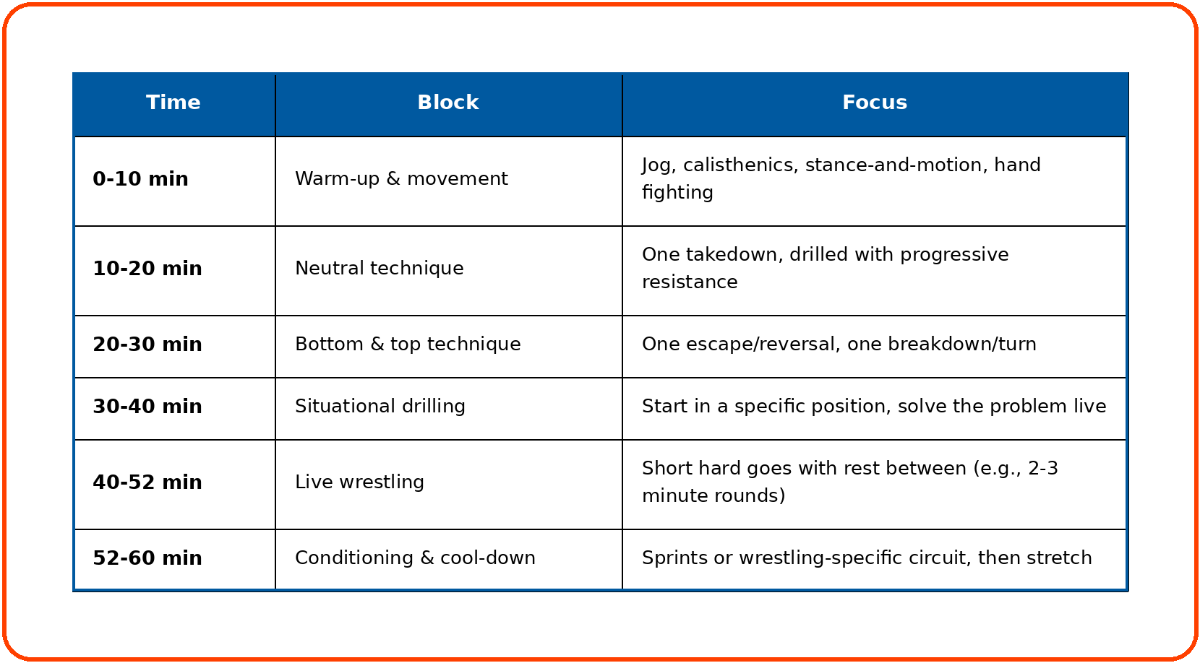
The point of the template is balance and repeatability. If every practice touches neutral, top, bottom, and conditioning, you improve everywhere instead of becoming a one-position wrestler.
Conditioning and strength training for wrestlers
Wrestling is one of the most physically demanding sports available. “You can be the better wrestler and still lose because you ran out of gas. Conditioning and strength are not optional.
Build your gas tank
Wrestling is quick bursts of maximum exertion with short recoveries, so your conditioning should look like that. Long slow running is not as effective for building the specific fitness a match requires as interval oriented practice (sprints, wrestling circuits, live goes with short break). Building your "gas tank" is when you continue to attack in the third quarter when your opponent is hanging on.
Strength that transfers to the mat
Strength work that develops full-body pulling, pushing, hip power, grip, and a strong neck and core is valuable for wrestlers. Compound actions and bodyweight strength such as pull-ups, push-ups, squats, hip hinges, and carries are effective. Heavy loading is not the goal; technique and supervision are the focus for young athletes.
Two rules of thumb:
- Strength is the servant of skill, not the other way around. Never trade technical time you need for more lifting.
- Grip and neck are more important than they appear. Powerful grips are the best kind of knots. Powerful necks don’t turn and won’t get injured.
The mental game: toughness, composure, and film study
Mental toughness in wrestling is a trainable skill, not just a personality feature. It’s formed the same way skills are: via repeated exposure and purposeful practice. The guys that can stay composed when they are behind, or when they are exhausted, or when they are wrestling a tough opponent, usually are the guys that have been in such situations many times in the room.
Three habits that build the mental game:
- "Wrestle on purpose in unfavorable positions. Start live is bottom or down on points, so pressure is a common thing.
- Do a little pre-match ritual. Warm up always and use a few cue phrases to settle nerves and focus.
- Watch films. Go back and watch your own matches and see what mistakes you keep doing. Watch good wrestlers and copy their technique and setups. A few minutes a week of focused film evaluation compounds. Don’t be a passive observer, look for one thing at a time (e.g. ‘why did I get scored on in the second period?’)
Nutrition and safe weight management (read this before you cut)
This is the most crucial part in this text, especially for parents and young wrestlers. Rapid weight loss by dehydration, starvation, or other severe measures is risky, hampers performance, and can be really harmful to the development of an athlete. An aggressive cut is not the way to get better in wrestling most of the time. For many young wrestlers the smartest thing is to wrestle at or near their natural weight.
The sad deaths of three university wrestlers in 1997 from rapid weight-loss attempts for extreme weight cutting vividly illustrated the hazards of the practice, prompting weight-management regulations in college and high school wrestling.
Today, high school and college wrestling have structured systems for weight control to protect the athletes. These programs usually include hydration testing and a body-composition assessment to determine a safe minimum weight class.
Practical, safe guidance for wrestlers and parents:
- Fuel for performance, not simply the scale. “Eating enough carbs, protein and fluids helps you wrestle better and recover faster.”
- Don’t starve yourself or dehydrate yourself to make weight. Dehydration affects strength, stamina and concentration, which are exactly what you want in a battle.
- Go see a professional. Add a coach who complies with the sanctioned program and, preferably, a physician or trained dietician, especially for young athletes, for any real weight-management plan.
- When in doubt, go up a weight class. A wrestler that is well-fueled beats one that is depleted.
Injury prevention and staying on the mat
If you are injured you can not improve. Availability is the best ability. Common wrestling problems are skin infections (ringworm, impetigo, herpes gladiatorum), joint injuries, concussions and cauliflower ear.
Sensible prevention:
- Hygiene prevents skin infections. Shower immediately after practice, wash gear after every practice, cover mat burns, and never wrestle with an untreated skin lesion. Clean mats regularly.
- Get warm and mobilize. Proper warm up and neck/shoulder/hip mobility lower strain damage.
- Wear a headpiece. It lowers the likelihood of cauliflower ear (auricular hematoma).
- Report head injuries. Concussions are serious and should be assessed by a competent health care expert.
- Respect the recuperation. Sleep, rest days, and responding to nagging pain will prevent worse problems.
The weekly "get better at wrestling" checklist
Use this as a repeatable weekly standard. Hitting most of these consistently is what improvement actually looks like.
- Drilled fundamentals (stance, motion, level change) at least 3 times
- Trained all three positions (neutral, top, bottom) during the week
- Wrestled live in multiple sessions
- Did situational drilling on my weakest position
- Completed dedicated conditioning work
- Did strength/mobility work appropriate for my age
- Watched at least a few minutes of film (mine or high-level matches)
- Ate and hydrated to fuel training, not just to make weight
- Got enough sleep and took at least one recovery day
- Fixed one specific mistake from last week
Common mistakes that stall your progress
- Collecting moves instead of mastering a few. Depth beats breadth. Own your best takedown before adding a fifth one.
- Only training takedowns. You will lose close matches on bottom and top. Train all three positions.
- Drilling without ever going live. Room technique that you cannot hit in a match is decoration.
- Going 100% live every day. No repetition of clean technique means you groove bad habits and get hurt.
- Ignoring conditioning. Skill you cannot sustain to the final whistle is not enough.
- Aggressive or unsupervised weight cutting. Dangerous, especially for youth, and it makes you wrestle worse.
- Skipping the mental side. No film study, no composure practice, no plan for when you are behind.
- Never resting. Overtraining and burnout end more careers than talent gaps do.
How coaches and clubs can make training more consistent
Much of the above depends on one unglamorous thing: continuous, well-structured training. Wrestlers perform better when practices start on time, when everyone knows the plan, when attendance and progress are documented and when parents are given open information regarding practices, weigh-ins and tournaments. That’s the exact organizational layer where a platform like SportsPlus fits in.
SportsPlus is a one-stop platform for sports organization management used by clubs, teams, and leagues, and a wrestling program can use that kind of tool to keep training consistent: scheduling practices and events, communicating with wrestlers and parents in one place, managing rosters and registration, and organizing tournaments and results.
The tool doesn't make anyone a better wrestler. Good organization removes friction so coaches can coach and athletes can obtain the constant reps that are what really drives growth.
The bottom line
Wrestling better is not rocket science but it is hard work. Develop your skills in the appropriate order, practice the fundamentals until they become automatic, grapple live enough to use them, condition as the sport actually is, train your head, and take care of your body with smart nutrition and safe weight practices. If you do this week after week, you will improve. Almost infrequently are the winners the ones with the most moves. They were the ones who performed the basics better, longer and with more heart.
If you are running a wrestling club or team, consistency is your multiplier. Learn how SportsPlus helps clubs, teams, and leagues plan practices, communicate with athletes and parents, and stay organized so your wrestlers receive the reps that matter.
Frequently Asked Questions
How long does it take to get good in wrestling?
Most wrestlers take a few of seasons to become really competitive and growth never really stops. If you can nail the fundamentals and grapple live consistently you can notice major gains in just one season. Wrestling has a steep learning curve at first, so novices can feel like they are making slow progress for months before things click.
What should a newbie get into first?
Stance, movement, one or two high-percentage takedowns, and a good escape from the bottom. Don't attempt fancy maneuvers. A strong foundation allows for all else.
Why Don't I Get Better at Wrestling?
Usually, the biggest reasons include practicing only one position, drilling and not going live (or vise versa), not conditioning, or not receiving enough continuous practice. Intentionally attack your weakest area from the weekly checklist.
What is the fastest way to improve at wrestling?
Learn a few basics by practicing them over and over, then obtain as many good live reps as possible while staying healthy. There's no shortcut to continuous, intentional practice, but working on foundations, not dazzling maneuvers, is the quickest honest way.
Drilling or live wrestling, which is more important?
Both, for different reasons. Drilling builds technique, real wrestling teaches you how to use it under duress. You're limited if you ignore one.
How many days a week do I need to wrestle?
What counts more than any specific figure is consistency. Practicing regularly each week during the season, with days of rest, brings about continuous growth.
How can I improve at wrestling at home?
Drill stance and motion, penetration steps, shadow wrestling and conditioning only. Do strength and mobility work. Resistance skills (finishes, escapes, live wrestling) still need a partner or a room.
How can I not get fatigued in the matches?
Conditioning should be like a match . High intensity bursts , short pauses , and live wrestling . Wrestling specific interval work, not just lengthy jogging. A better petrol tank.
How do I get better than bottom?
Get off on the whistle immediately. Work a good stand-up and sit-out. Do some situational drilling where you start on the bottom against resistance. Most wrestlers under-work this position and winning here wins close matches.
How do parents assist a young wrestler in getting better?
Be consistent about them practicing. Emphasize effort over results. Stress safe weight and dietary practices. Let the coaches do their job. Technical assistance from the stands is less important than good home routines and encouragement.
Is it safe for youngsters to lose weight for wrestling?
Aggressive weight cutting is not safe, and can be detrimental for young athletes who are growing. Most youth wrestlers should wrestle at or near their normal weight. Weight control should be done in accordance with sanctioned safety programs and ideally under the direction of a physician or nutritionist.
How do I improve mental toughness for wrestling?
Put yourself in tough spots in practice on purpose, create a pattern before the game, and watch film to make the nerves a plan. Toughness is not something you are born with, it is something you train in by regular exposure.
So, is off-season training really important?
Yes. The biggest jumps happen in the offseason freestyle, Greco-Roman, camps and strength work, because they increase mat time and physical growth without the strain of the competition season.

Nathan Uppara
Digital Marketing Lead at SportsPlus
Nathan Uppara is the Digital Marketing Lead at SportsPlus, where he helps sports organizations discover better ways to manage registration, payments, scheduling, communication, websites, and mobile apps. He combines his experience in digital marketing and sports technology to create practical content and resources for clubs, leagues, and sports organizations.
Latest in Coaching & Parenting

Smarter Sports Management with AI-Powered Features in SportsPlus
Jan 7, 2026187
Why High Schools Need All-In-One Sports Platform. A Guide for Athletic Directors
Oct 29, 2024379
How High Schools Can Leverage SportsPlus to Elevate Student-Athlete Success
Oct 24, 2024234
Why SportsPlus Outshines BigTeams for High School Sports Management
Oct 22, 2024245
How SportsPlus Streamlines Transactions Worldwide
Oct 1, 2024375
Popular in Coaching & Parenting

10 Best Basketball Quotes On Self-Motivation And Teamwork
Dec 14, 202311548
Top 6 Golf Online Stores
Dec 14, 202310965
Top 5 Tennis Online Stores
Dec 14, 20239073
How American sports programs compare to European sports programs.
Jan 16, 20245860
Top 10 Sports Website Builders Compared (Why Most Will Cost You Registrations)
Jun 18, 20241581