
How to Increase Baseball Pitching Velocity.

There are four elements that contribute to increasing pitching velocity: strengthening total-body strength and explosive force, improving mechanical efficiency so energy passes from the ground through the arm, following a planned throwing program, and regulating workload so the arm can adapt instead of break down. There is no one drill that will add 5 mph. Velocity is a byproduct of the system. Pitchers who train the entire system are going to get faster and stay healthier than pitchers who simply strive to throw harder.
This guide is created for pitchers from childhood ball through high school, and the parents, coaches, and league administrators responsible for their development. You will learn how speed is actually developed, what the science says about popular approaches like as weighted balls and long toss, realistic gain timetables, age appropriate training priorities and how to add speed without adding injury risk.
Key Takeaways
- Velocity is created from the ground up through the kinetic chain. 1The pitching motion begins on the ground with power moving from the legs through the hips, core, shoulder and arm before the baseball. Any weak links in that chain cost speed.
- “Arm strength is not the only thing that matters. Lower body power, rotational strength and hip to shoulder separation is more important.
- Weighted ball programs can increase velocity, but the injury evidence is mixed. A recent study of professional pitchers found that those who performed weighted ball training suffered more arm and trunk injuries than those who did not. These programs are not appropriate for young or skeletally immature pitchers.
- Long toss is useful up to moderate distances. Research shows throwing hard on a straight line up to about 180 feet produces biomechanics similar to mound pitching, while max-distance throws change mechanics and increase arm stress.
- The most common cause of youth arm injuries is overuse. Any velocity plan should leverage the MLB and USA Baseball Pitch Smart pitch count and rest rules.
- Most healthy, training-age-appropriate pitchers may realistically expect to add around 2-5 mph in a concentrated offseason, with growth playing a bigger role at the younger ages.
A pitcher's pitch speed is a function of how much force a pitcher can generate and how well that force is transferred to the baseball at the point of release. It’s the whole thing. Poor sequencing leaks energy for strong athlete. A mechanically clean athlete without strength has nothing to transmit.
Sports scientists call the delivery a kinetic chain. The pitcher pushes off the rubber and force passes from the legs through the hips, core, shoulder, arm and then into the baseball. Sports medicine professionals call this the kinetic chain because when all the links are working properly, velocity increases organically.
Within that chain, a few factors do most of the work:
Leg drive and ground force. The pitching motion is an energy transfer from ground force and the more a pitcher creates that energy and transfers it by pushing down the mound the more velocity increases .
Hip to shoulder separation. Shoulder separation is a big part of velocity. When the hips rotate to home plate and the shoulders stay back, it puts the core in a loaded position that stretches the core like a rubber band before snapping it forward.
A firm front side. Pitching against a strong front leg stops energy from leaking forward, so it continues up the body and transfers into the baseball.
Rate of force development. The relationship between strength and throwing velocity is not just about how much weight an athlete can lift. It is about how quickly force can be generated, which is why explosive exercises are so effective for pitchers.
Arm strength is real, but it is the last link in the chain, not the first. That is why the best velocity programs spend most of their time below the shoulder.
What Is the Average Pitching Velocity by Age?
Average fastball velocity rises steadily with age, growth, and training. Average fastball velocity climbs from roughly 40 to 50 mph at ages 9 to 10 to about 94 to 95 mph in MLB. 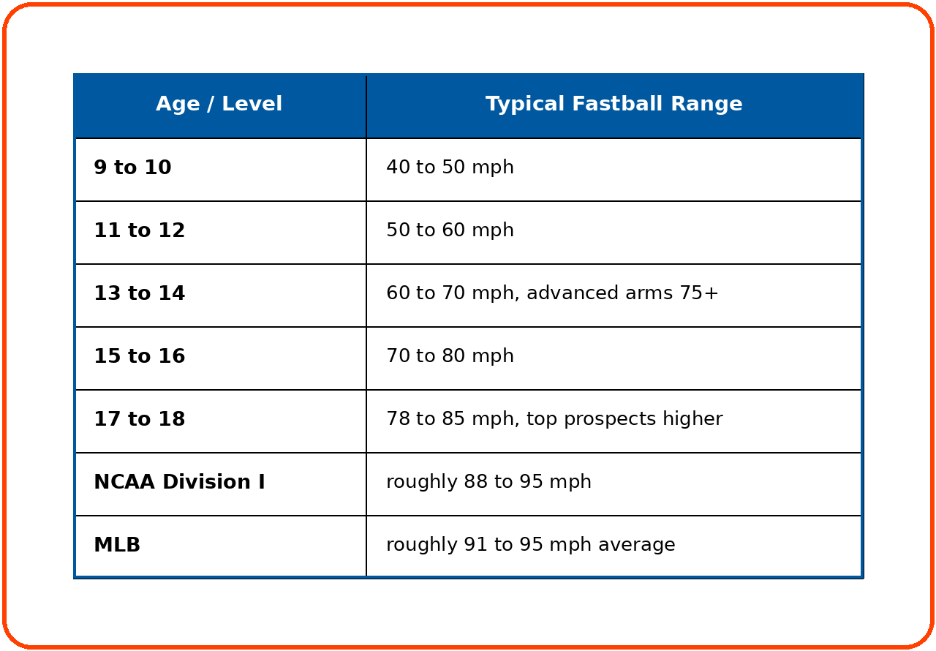
The ranges are based on recruiting and player development data. Little Leaguers 9-10 average 40-50 mph, 11-12 go to 50-60 mph, 13-14 hit 60-75 mph and 15-16 go to 70-80 mph. The average 14-year-old throws around 60-70 mph, 70-75 mph is good at that age, and a 14-year-old throwing 75+ is much above the curve. By the time they are 18, averages are about 78 to 85 mph. Division I programs typically recruit arms with 88 to 95+ mph stuff.
See these as markers for development, not verdicts. Ranges differ by source and measuring context, and a player will typically throw harder in a bullpen or one-pitch showcase than during five game innings. Two 12-year-olds can be 10 mph apart, simply due to when they hit their growth spurts, and the late bloomer often catches up.
The Velocity Development Stack: A Framework for Building Speed
Most velocity content is drills. Drills are the least important thing. The order in which capacities are built is what counts. We employ a four-layer paradigm named the Velocity Development Stack. Each layer supports the one above it, and pitchers can damaged by skipping a layer.
Layer 1: Foundation (mobility, movement quality, arm care) Hip and thoracic spine mobility Shoulder range of motion and scapular control Basic body control Without this, extra strength cannot be safely communicated.
Layer 2: Force (general strength). Squat patterns, hinge patterns, single-leg strength, core and rotational strength. This is the engine.
Layer 3: Transfer (explosive and sport-specific power). Plyometrics, medicine ball throws, sprinting, and a structured throwing program that converts strength into arm speed.
Layer 4: Workload (volume, recovery, and monitoring). Pitch counts, rest days, offseason planning, and velocity tracking. This layer decides whether the other three produce gains or injuries.
This ordering reflects a common failure pattern coaches see everywhere. Many baseball players cut corners and jump straight to velocity programs without establishing a proper foundation. Essentially they are worried about the frosting before they bake the cake.
How Do You Increase Pitching Velocity? Step by Step
Step 1: Get the mechanics evaluated before adding intensity
Poor mechanics that have a pitcher throwing harder put more stress on the elbow and shoulder. To achieve velocity, a pitcher must first understand the fundamentals of pitching mechanics, beginning with video analysis, coaching feedback, and specific workouts to improve sequencing and coordination.
Practical starting points: video the delivery from the open side and from behind at every bullpen, make sure that the hips clearly lead the shoulders into rotation and look for a solid front leg upon release. At this level a good pitching coach or a biomechanics assessment is worth considerably more than any device.
Step 2: Build lower-body and rotational strength
The legs and trunk produce most of the force in the delivery. The hamstrings and glutes are among the most powerful muscles in a pitcher's body, and building lower-body strength adds lean muscle mass for athletic performance. There is also a documented relationship between body mass and velocity: gaining lean muscle mass gives players more force moving down the mound, though players must not get too big too fast and lose stability.
Trap bar deadlifts, rear-foot elevated split squats, single-leg RDLs, lateral lunges, anti-rotation core training (Pallof presses, dead bugs) and rotational medicine ball tosses are core staples for high school pitchers. They should initially learn the bodyweight variants.
Step 3: Train explosiveness, not just strength
Velocity is a reward for quick force. Plyometric workouts develop muscles to produce force fast, and that’s exactly what the pitching action is all about. There are box jumps, broad jumps, lateral bounds and sprints.
Medicine ball throws deserve special mention because they train the exact rotational pattern of pitching with load the arm can tolerate. Scoop tosses, rotational shot-put throws, and overhead slams against a wall let pitchers train intent aggressively. Players can continue getting explosive reps even on days when their arm does not feel fresh.
Step 4: Follow a structured throwing program
Throwing itself is a skill and a stimulus. A good program progresses volume and intensity gradually across the offseason: catch play, long toss to moderate distances, drill work (rocker throws, step-behinds), and bullpens with radar feedback so intent stays high. Random throwing does not build velocity. Progressive, planned throwing does.
Step 5: Make arm care non-negotiable
More velocity means more stress on the arm, which makes the small stabilizing muscles the seatbelt of the whole system. Because more velocity means more stress on the arm, a structured arm care plan should include scapular stability work such as band pull-aparts, rotator cuff strength work such as banded internal and external rotations, forearm training, and recovery, and pitchers who consistently perform arm care tend to stay healthier and keep improving.
Ten to fifteen minutes of band work and scapular control exercises, three to four days per week, is a realistic standard for a high school pitcher.
Step 6: Manage workload and sleep like they are training variables
Adaptation happens during recovery, not during throwing. Pitchers chasing velocity while short on sleep, throwing year-round, or pitching for two teams simultaneously are training to get hurt. Workload rules are covered in detail below because they matter enough to be their own section.
Do Weighted Baseballs Increase Pitching Velocity?
Weighted ball programs can increase velocity, but the evidence on injury risk is genuinely mixed, and they are not appropriate for young or skeletally immature pitchers.
The performance case is real. A prospective multicenter study found the majority of high school pitchers reported using weighted ball programs, and these programs were associated with increased average and peak velocity compared to pitchers who did not use them. These programs typically use both heavy and light balls: weighted baseball training commonly involves overweight, underweight, and standard 5-ounce baseballs, with commercial weights ranging from 2 ounces to over 32 ounces.
The safety picture is less comfortable. In a recent interim safety analysis of professional pitchers, those using weighted ball training had an arm injury rate of 11.8 per 1,000 game exposures versus 7.5 for non-users, a trunk injury rate of 5.9 versus 2.1, and the authors concluded that pitchers performing weighted ball training suffered greater arm and trunk injuries. Meanwhile, the high school study found no significant differences in injury history between users and non-users, and its authors noted that further study is needed to understand the injury risk.
Our recommendation: Weighted balls are a tool for physically mature pitchers (usually 15 or 16 and older) with a proven strength base, in a supervised, progressive program in the offseason. They are not a shortcut for a 12 year old and should never run concurrently with a competitive pitching schedule.
Does Long Toss Increase Pitching Velocity?
Long toss builds arm strength and throwing capacity, and moderate-distance long toss is biomechanically sound. Max-distance long toss is where the trade-offs start.
Research by Dr. Glenn Fleisig and colleagues found that throwing the ball hard and in a straight line at distances up to 180 feet produces biomechanics similar to pitching from a mound. That makes line-drive long toss to around 120 to 180 feet a reasonable staple of a throwing program.
Maximum-distance throwing is a different animal. Maximum-distance throws lead to increased torques and altered kinematics, suggesting the need for caution when using these throws in training and rehabilitation. In the ASMI research, pitchers asked to throw as far as they could averaged 264 feet, and doing so produced a 10 percent increase in both elbow varus torque and shoulder internal rotation torque.
Practical translation: long toss on a line to moderate distance is a low-risk velocity builder. Save max-distance "air it out" throwing for occasional, carefully progressed use by mature pitchers, if it is used at all.
How Much Velocity Can a Pitcher Realistically Gain?
Most healthy pitchers gain about 2-5 mph via a dedicated offseason of strength development, pitching progression and recovery. For teenagers, growth piles on top. The average pitcher will pick up 3 to 5 mph from freshman to senior year just due to natural growth, some will experience leaps of 8 to 10+ mph, and structured strength training usually adds 2 to 4 mph.
Two honest caveats. First, gains are not linear. A pitcher might add 4 mph in one offseason and 1 mph the next. Second, marketing claims of "add 7 mph in 12 weeks" describe outliers, not averages. Many velocity programs marketed on the internet have not been validated scientifically as safe or effective through controlled and unbiased research. Judge any program by whether it builds all four layers of the stack, not by its best testimonial.
How Do You Increase Velocity Without Increasing Injury Risk?
Follow the Pitch Smart recommendations and consider workload part of the velocity program not an obstacle to it.
Overuse, not velocity training itself, is the most consistently reported contributor of injury in young baseball. The single biggest item demonstrated to increase young pitching injuries more than anything is overuse. Injured young pitchers throw more pitches a game and more innings a year and more months out of the year.
Major League Baseball and USA Baseball created the Pitch Smart guidelines together to make recommendations to assist reduce the risk of injury from over-throwing. What every velocity-minded family and coach needs to know:
- Daily pitch restrictions by age, mandatory rest. For example, a 10-year-old is limited to 75 pitches a day, and 21 to 35 pitches before a day of rest is required, while a 17-year-old is allowed to throw a maximum of 105 pitches in a game. Full charts by age can be seen at PitchSmart.org.
- No pitching three days in a row. Regardless of pitch counts, pitchers should not be used as pitchers three days in a row in a game.
- An offseason, for real. Youth pitchers should throw no more than eight months each year and take at least four months off from overhead throwing in a row. This rest interval is one of the strongest preventative factors against overuse injury.
Compliance is worse than most parents realize, especially in tournament play. One study of 100 youth tournament teams indicated that more than 90 percent of teams and nearly half of all pitchers did not comply with Pitch Smart standards . Noncompliance was connected with younger age, high-volume pitching and pitching in consecutive games . If your league or tournament is not systematically tracking pitch counts, that’s a governance problem that needs fixing before anyone concerns about raising velocity.
Velocity Training Priorities by Age 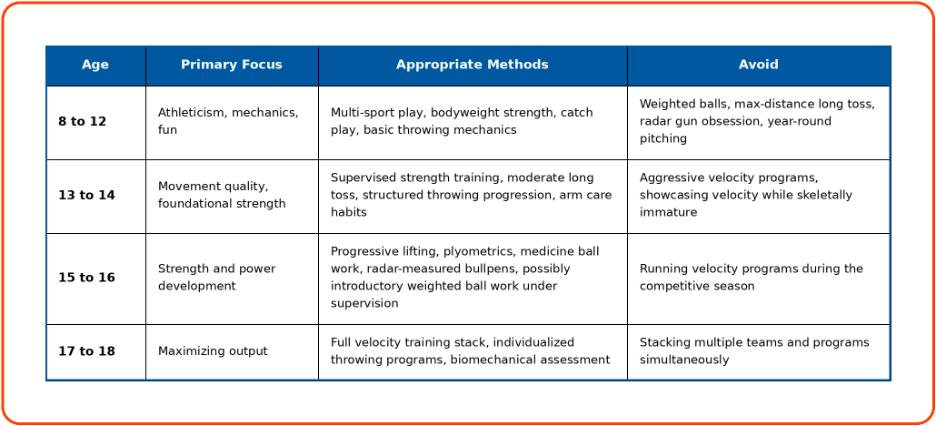
The youngest rows are strongly supported in their logic. Mechanics and coordination are much more important than speed around 10 to 12 years old. Trying to go after speed too early typically leads to undesirable habits. Velocity is a lot less important for future recruiting than arm health, good mechanics and a repeatable delivery in the early teens.
What Are the Most Common Velocity Training Mistakes?
- Chasing velocity before building a foundation. Strength and mobility come first. Programs bolted onto a weak base produce injuries, not mph.
- Training velocity during the season. High-intent velocity work and competitive pitching are two separate stressors. Stack them and something gives, usually the elbow.
- Ignoring the lower half. A pitcher who does endless band work but never trains legs is polishing the last link of the chain while the first link rusts.
- Copying a pro program. Professional pitchers have training ages, medical staff, and recovery resources a 15-year-old does not.
- Playing for multiple teams with no shared pitch tracking. It is ultimately the responsibility of the parent and athlete to ensure the player follows the guidelines for his age group over the course of a year, given that he will often play in multiple leagues with different affiliations. Nobody else sees the whole picture unless someone tracks it.
- Measuring nothing. Without regular radar readings under consistent conditions, nobody knows whether the program is working.
What Can Coaches and Leagues Do to Support Velocity Development Safely?
Individual pitchers control their training. Coaches and leagues control the environment, and the environment decides whether training gains survive the season.
Three things matter most at the organizational level:
Track pitch counts across every game. Paper scorebooks and memory are how violations happen. Given that most documented Pitch Smart violations involve insufficient rest between appearances rather than single-game overloads, leagues need records that persist across games and weeks, not just a clicker in one dugout. In one youth baseball study, 93 percent of guideline violations involved insufficient rest between games rather than exceeding daily pitch maximums.
Schedule with rest in mind. Tournament formats that force teams to play four games in two days push coaches toward reusing arms. Administrators who build rest windows into schedules remove that temptation.
Keep records visible to parents. When families can see appearance history and stats, workload conversations happen before an injury instead of after.
This is where a sports management platform earns its keep for baseball organizations. SportsPlus gives leagues, clubs, and tournament operators a single system for scheduling, rosters, game results, player statistics, and team-to-parent communication, which means appearance histories and player workload information live in one place that coaches and administrators can actually check between games. For a league trying to enforce rest rules across dozens of teams, centralized scheduling and stat records are the difference between a policy on paper and a policy in practice.
Final Takeaway
Velocity is layered. Build the foundation. Build strength. Convert it to explosive power with a structured throwing program. Protect all of it with disciplined workload control. Watch out for any program that guarantees you a set number, and watch out double for any plan that makes no provision for age. Best velocity program for a 12 year old involves athleticism, mechanics, and patience. A 17 year old’s is a full training stack done regularly through an offseason.
For coaches and administrators: the best velocity contribution you can give is an environment that tracks, rests and develops young arms in a timely manner. If your league is still managing schedules, rosters, and pitching records via spreadsheets and text threads, see how SportsPlus can offer you scheduling, stats, and club communication in one system so that player development and player safety don't depend on memory.

Nathan Uppara
Digital Marketing Lead at SportsPlus
Nathan Uppara is the Digital Marketing Lead at SportsPlus, where he helps sports organizations discover better ways to manage registration, payments, scheduling, communication, websites, and mobile apps. He combines his experience in digital marketing and sports technology to create practical content and resources for clubs, leagues, and sports organizations.
Latest in Coaching & Parenting

Smarter Sports Management with AI-Powered Features in SportsPlus
Jan 7, 2026187
Why High Schools Need All-In-One Sports Platform. A Guide for Athletic Directors
Oct 29, 2024379
How High Schools Can Leverage SportsPlus to Elevate Student-Athlete Success
Oct 24, 2024234
Why SportsPlus Outshines BigTeams for High School Sports Management
Oct 22, 2024245
How SportsPlus Streamlines Transactions Worldwide
Oct 1, 2024375
Popular in Coaching & Parenting

10 Best Basketball Quotes On Self-Motivation And Teamwork
Dec 14, 202311548
Top 6 Golf Online Stores
Dec 14, 202310965
Top 5 Tennis Online Stores
Dec 14, 20239073
How American sports programs compare to European sports programs.
Jan 16, 20245860
Top 10 Sports Website Builders Compared (Why Most Will Cost You Registrations)
Jun 18, 20241581